The Salt Belt States
Road salt. It's great for melting ice, and awful for just about everything else.
Cold-weather states that have to use a heavy dose of salt in the winter are sometimes referred to as the “salt belt.” Every now and again you’ll see a recall or investigation that is limited to this this specific region.
Understandably, the “salt belt” is also known as the “rust belt.”
“The biggest threat salt poses to a vehicle is rust, which is accelerated by repeated exposure to salt. Rust on certain parts of a car can create a slew of problems ranging from hydraulic brake system leaks to subframe damage.” — Accuweather.com
The states in this belt are, as you’d expect, found in New England, the Mid-Atlantic and the upper Midwest. The belt, however, sometimes grows or shrinks depending on the recall.
The “Salt Belt” 21
Here are the 21 states (plus one district) that you’ll almost always see listed as part of the “salt belt”:
Connecticut, Delaware, Illinois, Indiana, Iowa, Maine, Maryland, Massachusetts, Michigan, Minnesota, Missouri, New Hampshire, New Jersey, New York, Ohio, Pennsylvania, Rhode Island, Vermont, Virginia, West Virginia, Wisconsin and Washington D.C.
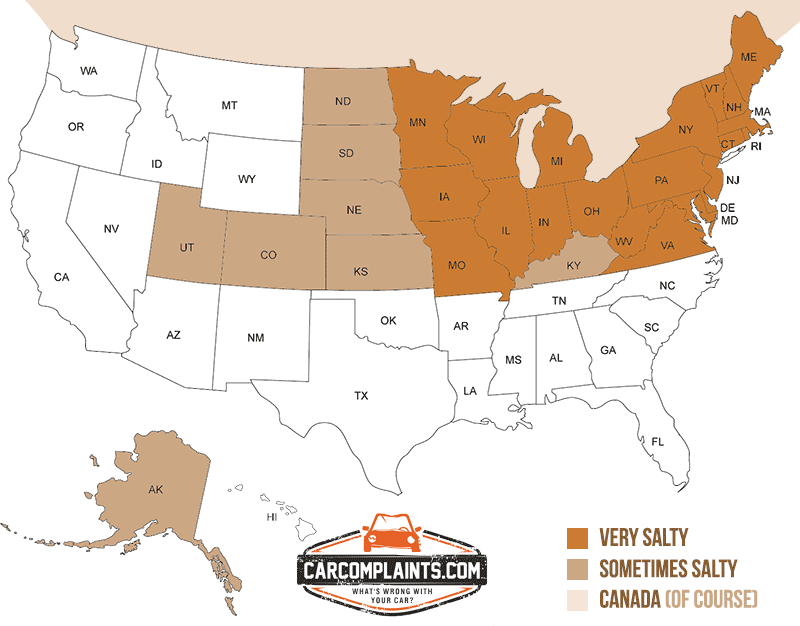
Depending on what models are being recalled, Canada can be included too because, well … it’s Canada and it snows a lot there.
“Why isn’t Alaska on the primary [salt belt] list? Maybe Alaskans don’t like road salt. Maybe they just ride around on polar bears all winter. I’ve never been, so I can’t say for sure.”
Other states such as Alaska, Colorado, Kansas, Kentucky, Nebraska, North Dakota, South Dakota, Utah are also sometimes considered part of the “salt belt.”
Why isn’t Alaska, our northernmost and one of the snowiest states, on the primary list? I’m not really sure. Maybe Alaskans don’t like road salt. Maybe they just ride around on polar bears all winter. I’ve never been, so I can’t say for sure.
The Reason For All This Salt
Salt is used on roads because it helps lower the melting point of ice, to a point. A 10% salt solution will lower water’s freezing point from 32 F (0 C) to 20 F (–6 C). But once it starts to get colder things get a little science-y and salt’s effectiveness starts to fade.
How Salt Affects Your Car
Salt has a nasty habit of finding places where it can do the most damage. Take that small nick in the paint of your car that came courtesy of a rogue shopping cart. Salt will nestle in past the paint, attach itself top your car’s exposed metal frame and eat that sucker dry. Salt will also eat through:
- Your paint, if you haven’t properly waxed
- Your struts and shocks
- Fuel tanks and other components if there are bad welds
- Brake lines and other good times
To combat salt corrosive awfulness, manufacturers will sometimes treat your car with anti-rust sprays, zinc-rich galvanizing compounds and rubberized underbody coatings that work … for a while. Sometimes you’ll even receive an anti-corrosion warranty with a new car that lasts a couple years.
Preventing Rust and Corrosion on Your Car
Your best bet is to wax your car before winter and then regularly wash it, when you can, throughout the cold months.
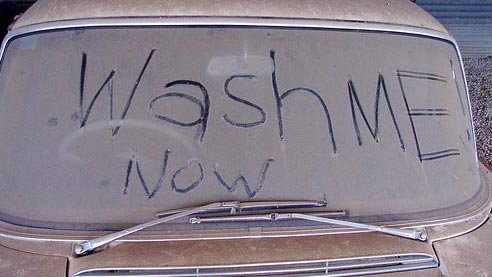
Some say that salt’s corrosive properties slow down once the salt dries into a crusty white dust all over your car. Those people are very wrong and you should never take advice from them again.
“Go through a car wash that has an under-spray,” says Manager of Vehicle Services at Firestone Complete AutoCare, Joe Roger “That will try to reduce the chances that all that salt and salt water will get on the vehicle and start to corrode.”
Salt Belt News
-
Ford Explorer Rear Toe Link Recall Expanded Ford recalls more than 412,000 Explorers not included in a previous toe link failure recall.
-250.png)
— More than 412,000 Ford Explorers are recalled because the rear suspension toe links may fracture. The toe link recall includes 2017-2019 Ford Explorer SUVs that could suffer steering problems if the toe links break. This recall is an expansion of a July 2021 recall of nearly 775,000 Ford Explorers worldwide for rear toe link problems. According to Ford: "Affected vehicles are equipped with cross-axis ball joint (CABJ) parts manufactured by SAF and rear ...
-
Ford Mustang Recall Involves 355,000 Cars Road salt and water can corrode the front seat belt anchor pretensioner cables.

— Ford has recalled nearly 355,000 Mustangs because road salt and water can corrode the front seat belt anchor pretensioner cables. The recalled 2015-2017 Ford Mustang cables can break from corrosion and leave the seat belts fairly useless. "Exposure to a corrosive environment (where use of road salt is prevalent in winter months as an example) may result in this condition. The seatbelt anchor pretensioner assembly is contacted by carpet and underlayment ...
-
Ford's 115th Safety Recall of 2025: Engine Block Heaters Ford recalls more than 59,000 vehicles and warns owners not to plug in the engine block heaters.
-75.png)
— A Ford engine block heater recall has been issued for more than 59,000 vehicles and Ford is warning owners not to plug in the heaters until they are replaced. The engine block heater recall involves these Ford and Lincoln models. 2016-2019 Lincoln MKC 2016-2023 Ford Explorer 2019-2020 Ford Fusion 2019-2024 Ford Ranger 2020-2022 Lincoln Corsair 2020-2022 Ford Escape 2021-2024 Ford Bronco 2021-2024 Ford Bronco Sport 2022-2024 ...
-
Mitsubishi Outlander Liftgate Recall Includes 154,000 SUVs Mitsubishi Outlander and Outlander PHEV tailgates can fail due to corrosion from salt water.

— Mitsubishi Outlander liftgate problems have caused a recall of nearly 154,000 SUVs in Canada and certain U.S. states. The recall involves 2018-2022 Outlander PHEV (plug-in hybrid electric vehicle) and 2014-2020 Outlander SUVs equipped with liftgate gas spring cylinders that may corrode and lose pressure. This can cause the Outlander liftgates to fail and suddenly fall. The recall affects 2018-2022 Mitsubishi Outlander PHEV and 2014-2020 Outlander SUVs in ...
-
Recall of 2013 Honda Accords Issued For Broken Driveshafts Honda recalls 65,000 Accords in an expanded driveshaft recall originally issued in 2020.

— Honda has recalled more than 65,000 model year 2013 Honda Accord cars for driveshaft problems, but only if they are equipped with 4-cylinder engines and continuously variable transmissions. The 2013 Honda Accord driveshaft recall is an expansion of a December 2020 recall of 220,000 model year 2013-2015 Honda Accord cars. The latest driveshaft recall involves Accords originally sold or ever registered in these states: Connecticut, Delaware, District of ...
-250.png)

-75.png)

